
IN-PERSON WORKSHOP at Eighmy Powerhouse
This is a paid Festival program with limited capacity. Registration is required.
Part of the 2026 Tell It Slant Poetry Festival!
Join us for the 14th annual Tell it Slant Poetry Festival, a week of events happening both online and in-person at the Museum!
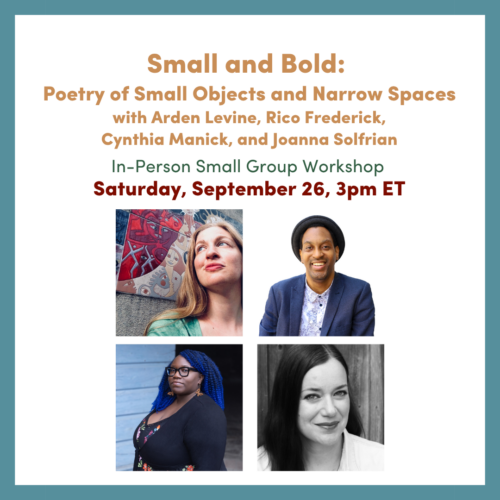 Dickinson examined, studied, and utilized tiny items and tight envelope contours in the service of poem-making. This two-part workshop will discuss how the constraint of shape and size forces creativity: We will first meditate on a small, everyday object and honor it in the creation of a poem; we will then consider how restricted page space makes a poem even more expansive. Led by four apartment-dwelling Brooklynite poet-educators (including one urban planner and one visual designer), participants will make and share poems that reveal the “passing Universe” in minute ephemera and confines.
About the presenters
Arden Levine is the author of Spoke (The Word Works’ Hilary Tham Capital Collection, 2026) and Ladies’ Abecedary (Harbor Editions, 2021). A 2024 National Poetry Series finalist and a National Book Critics Circle member, her writing appears in AGNI, Barrow Street, Harvard Review, RHINO, and elsewhere, and has been featured by the Poetry Foundation and Poetry Society of America. Arden lives in New York City and works in urban housing policy and community development.
Rico Frederick is an Adjunct Professor at Rutgers University-Newark, a Trinidadian transplant, and the author of the poetry collection Broken Calypsonian (Penmanship Books, 2014). He holds an MFA in Writing from Pratt Institute and is a NYSCA/NYFA Artist Fellowship finalist, Fulbright semi-finalist, Cave Canem Fellow, Poets House Emerging Poets Fellow, Pushcart nominee, and the first poet to represent all four original New York City poetry venues at the National Poetry Slam.
Cynthia Manick is the author of No Sweet Without Brine (Amistad-HarperCollins, 2023), a New York Public Library Best Book of 2023 and a Ms. Magazine “Best Poetry of the Last Year (2023)”. She is editor of The Future of Black: Afrofuturism, Black Comics, and Superhero Poetry; and author of Blue Hallelujahs. Her work has appeared in the Academy of American Poets Poem-A-Day Series, Brooklyn Rail, The Rumpus and elsewhere. She lives in New York City.
Joanna Solfrian’s first book, Visible Heavens, was chosen by Naomi Shihab Nye for the 2009 Stan and Tom Wick Poetry Prize. She is also the author of The Mud Room (MadHat Press, 2020) and Temporary Beast (Beltway Editions, 2024). Her poems have appeared in The Harvard Review, Boulevard, Rattle, Margie, The Southern Review, Salamander, Pleiades, Image, and elsewhere. A MacDowell Fellow and a six-time Pushcart nominee, Joanna lives and works in New York City.
Support The Tell It Slant Poetry Festival
The Tell It Slant Poetry Festival is sustained by the Emily Dickinson Fund, which provides critical, unrestricted support for the Museum’s day-to-day operations. Your generous donation helps us offer immersive poetry programs to a global audience and preserve the historic Dickinson legacy in Amherst. As the Fund supplies 36% of our annual budget, your tax-deductible contribution is essential to our mission. Join us in inspiring learners of all ages by making an immediate impact today.
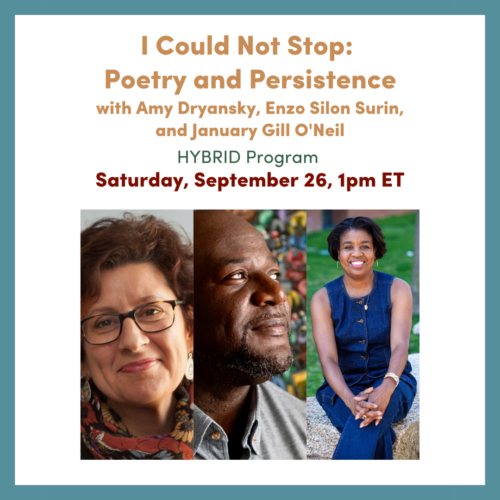 January, Enzo and Amy are award-winning poets and Massachusetts Book Award honorees, but their paths to success weren’t easy. All three writers are parents, wage earners, and in some cases, caregivers, with multiple community and professional connections and responsibilities. Like Dickinson, each of these poets has at times wished they could bolt the door to their room and simply be left alone with their words. This interactive panel, reading, and discussion will open the door to those conflicting demands and provide strategies — and, hopefully, inspiration—for those in a similar predicament, those who “could not stop.”
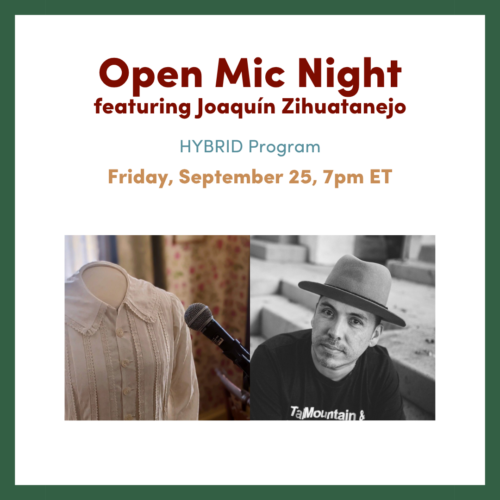
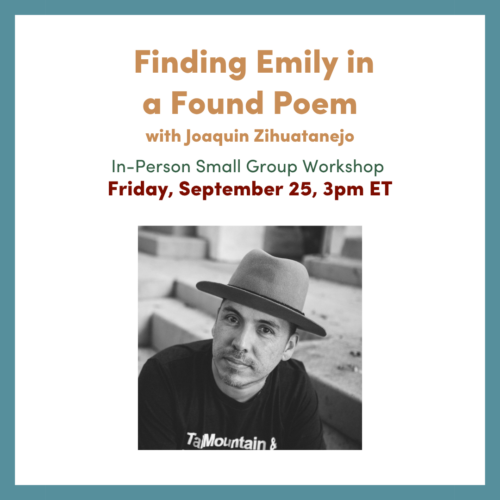 In this interactive, generative workshop, poets will explore the language and themes of Emily Dickinson – at a slant. To honor Dickinson’s breathtakingly odd and brilliant work, poets will create group poems in the voice of a collective ‘we’. Poets will create found poems by combining their own words with words found in poems by Emily Dickinson. Sound intimidating? It will not be, as two-time World Poetry Slam champion, Joaquín Zihuatanejo, will be there to guide us along the way.
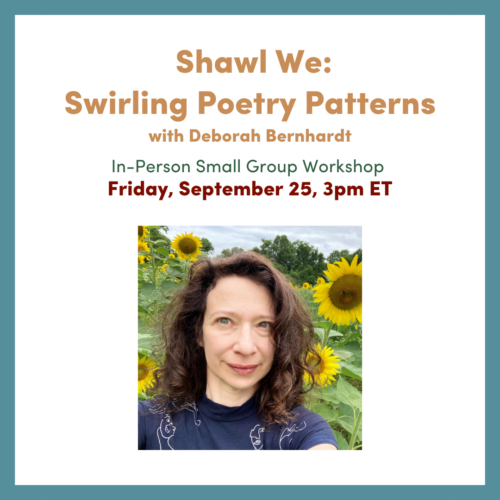 In this poetry workshop, we shall visit a colorful mystery: a ten-foot shawl which possibly belonged to a wren-size poet. Did Emily Dickinson wear this? Sitting at her window desk, looking out toward The Evergreens? Suddenly thrown about her as she wandered into the garden, visiting a robin? In bed, contemplating a wild night? After exploring some Dickinson poems which use patterns analogous to the shawl’s, participants will be invited to write lines which are inspired by the shawl’s patterns, inspired by imaginings of Dickinson wearing the shawl, or by both aspects. “Artists wrestled here!/Lo, a tint Cashmere!/Lo, a Rose!”—F11A
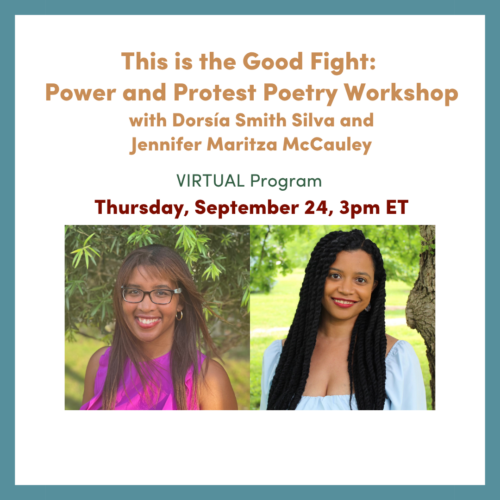 This workshop is for all writers to explore the meaningful relationship between protest and power. With the rise of protests in today’s society, writers can use their craft as a tool of resistance and collective action. This diverse panel with Black, Puerto Rican, activist writers and professors of literature in the U.S. and Puerto Rico will share helpful writing strategies and prompts for writers to incorporate protest into their writing and daily craft practices. Through a series of prompts and sample poems, the audience will leave the workshop with at least one draft of a new poem.
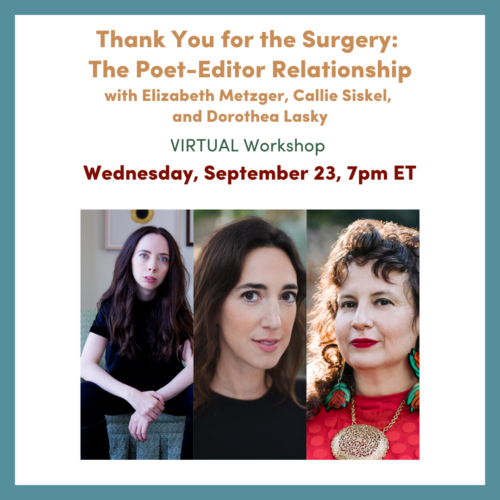 Callie Siskel and Elizabeth Metzger, poetry co-editors at the Los Angeles Review of Books, and poet Dorothea Lasky, will use the Higginson-Dickinson correspondence to consider the role of the poet as editor or editor as poet today and rethink our assumptions about the editor. Beyond the aim of publishing our work as poets, how might we see the conversation between poet and editor today as expanding possible pathways of creativity? We often think about the relationship between poet and reader, but the special role of the poet-editor offers an intermediary process that has the opportunity to transform, elevate, or pressurize our solitary artistic visions–sometimes by offering concrete feedback, sometimes by asking us to formulate our aesthetic vision or reconsider our projects and values, and other times simply by creating space in our society for a larger conversation around poetry, life, and listening. In a poetry world in which many editors are poets themselves, and a main avenue for becoming a poet is the workshop classroom, how might the editor-poet relationship create a correspondence that is at once formative, supportive, and expansive, and a relationship that is personally and professionally meaningful and ideally non-hierarchical?
 Time travel with Emily Dickinson from her clockless childhood to eternity’s carriage ride. During this generative workshop, we’ll explore time’s slant in Dickinson’s poetics, then leap into the present to write our own time travel poems in the contemporary ‘century’ form — a 100-word prose poem. Using Dickinson’s lines as launchpads, craft yours decade-by-decade through short timed prompts. We’ll cap this with ‘bursts of now’: 100-second single-image sprints! Add numerical and temporal play to your poetic toolbox and leave with fresh work.
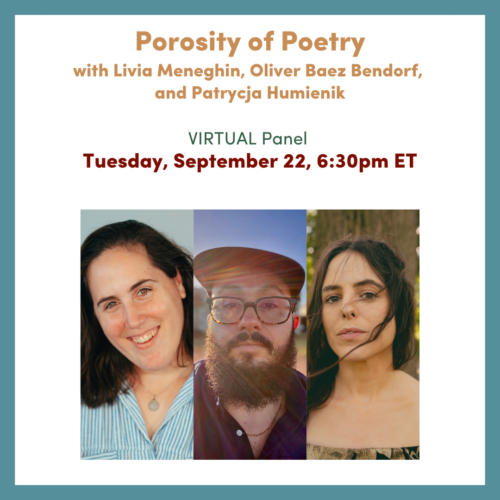 Enjoy short readings and discussion in response to the idea that poetry acts as filter and sponge for the world to enter, reveal, and inspire. What meanings are our words saturated with, and where does that discovery lead? When do environmental, historical, and sociopolitical realities flood the page? How does the body’s experience of writing impact the poetry itself? At this panel, poets Oliver Baez Bendorf, Patrycja Humienik, and Livia Meneghin will share poetry in response to these understandings of porosity and discuss living within and between language, when and how poetry can surprise us, and where Emily Dickinson’s poetry serves as example.
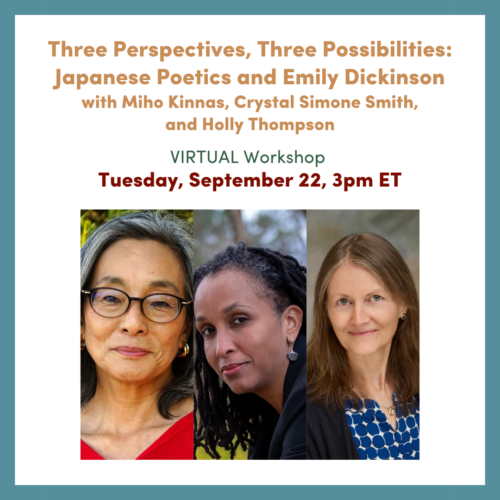 This workshop will offer three perspectives from Japanese literature—haiku, tanka and haibun—in connection to Emily Dickinson’s poetry. Acclaimed craftswomen of these forms will share a wide range of example works including 10th-century zuihitsu, poems by a 19th-century Japanese female poet (a contemporary of Emily Dickinson), haiku based on the African American experience, as well as their own work inspired by respective examples. The audience will be given writing prompts and invited to share their works and discuss.